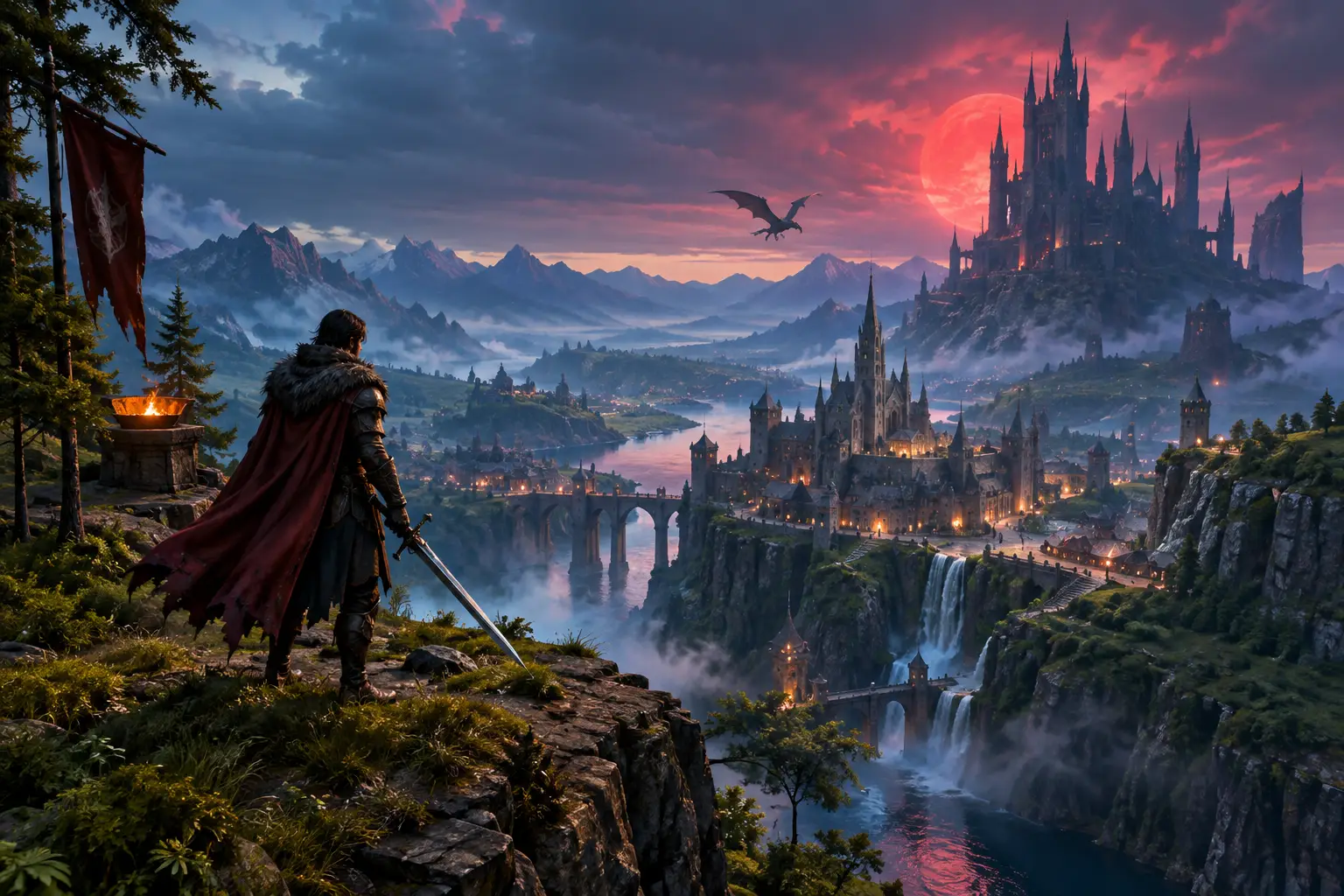
The torch sputters in the crypt. Somewhere beyond the broken sarcophagi, something has learned your name. You could run, bargain, draw steel, or call upon the power you swore never to use again. That is the promise of a dark fantasy rpg: not a tale where heroes are protected from the shadows, but a realm where they choose what they will become inside them.
Dark fantasy is not simply fantasy with more graveyards. It is a genre of pressure, consequence, and difficult beauty. Its kingdoms may be magnificent, its magic celestial, its heroes capable of astonishing acts, yet every crown has a cost and every miracle leaves a mark. For roleplayers and collaborative writers, that tension creates a world worth returning to. Your character is not waiting for a script to tell them who they are. They are forging an identity under fire.
What a Dark Fantasy RPG Asks of You
A bright fantasy adventure often begins with a clear promise: evil rises, a champion answers, and courage carries the day. A dark fantasy roleplay setting asks harder questions. What if the champion is frightened? What if the kingdom deserves saving but its ruler does not? What if the monster at the gate was made by the people asking for help?
These questions do not make a story hopeless. They make hope meaningful. When safety is scarce, offering shelter matters. When power corrupts, choosing restraint becomes an act of character. When an old god answers a prayer, the true drama may lie in what it demands in return.
That is why the strongest dark fantasy roleplay is never darkness for its own sake. Relentless misery eventually flattens a setting. If every village burns, every ally betrays, and every choice ends in ruin, players stop feeling danger and start feeling distance. A living realm needs contrast: a warm inn against a blizzard, a loyal companion in a treacherous court, a small victory that survives long enough to be celebrated.
The shadows give light its shape. Your hero does not need to be pure to matter. They need desires, convictions, scars, and choices that can change the road ahead.
A Hero Is More Than a Character Sheet
In a memorable roleplay world, character creation is the first act of authorship. A name, lineage, class, or weapon can establish a silhouette, but the deeper work begins with a wound and a want. What did your hero lose? What will they cross a continent to claim? What line do they believe they will never cross?
A disgraced knight is familiar. A disgraced knight who still polishes the insignia of the order that abandoned her has a story already moving. A necromancer is familiar. A necromancer who raises the dead only to recover the final words of the forgotten has a moral center others can challenge, fear, or protect.
The best concepts leave room for discovery. You do not need to arrive with every secret mapped and every future victory decided. In fact, a character becomes easier to play when some of their answers are unfinished. Leave a blank space in their past. Give them a belief that another player can test. Create a goal that requires allies, rivals, and dangerous places.
This is where collaborative roleplay offers something a solitary story cannot. Another writer can become the witness to your hero's worst choice. A stranger's character can turn into the friend who makes redemption possible, the enemy who understands too much, or the companion whose death changes everything. You bring the spark. The shared world gives it oxygen.
The Realm Must Remember
A dark fantasy RPG gains force when its setting feels older than any one protagonist and responsive to those who enter it. Ruined temples, bloodline feuds, forbidden forests, and fallen empires are compelling because they imply that history has teeth. Yet lore should be an invitation, not a wall.
A vast setting needs enough structure to make choices legible. If a region is ruled by a dying dynasty, a newcomer should understand why serving the throne, opposing it, or ignoring it can each lead to a different kind of trouble. If magic has a price, that price should shape politics, faith, and ordinary life. If the sea is haunted, sailors should tell stories that influence how people travel, trade, and mourn.
At the same time, no player wants to study a library before writing a first scene. Good worldbuilding provides handholds: factions with motives, locations with atmosphere, conflicts already in motion, and room between established facts for new legends. The world should feel complete enough to trust and open enough to alter.
That balance is especially powerful across multiple realms and continents. One character may chase a stolen relic through rain-soaked borderlands. Another may serve in the court of a star-crowned tyrant across the sea. Their paths can remain distinct for months, then collide over a treaty, a prophecy, or a threat neither could face alone. Scale makes personal stories feel consequential without demanding that every character save the world by Tuesday.
Consequence Makes Choice Matter
The word "dark" can tempt writers toward constant escalation: bigger demons, crueler rulers, bloodier battles. Spectacle has its place, but consequences are more enduring than shock. The scene that stays with players may be a duel beneath an eclipse. It may also be the quiet aftermath, when the survivor must decide whether to tell the truth.
Meaningful consequences do not require punishing every decision. They require the world to respond. A promise made to a frightened village might earn trust, create an obligation, or make an enemy of someone who profited from that village's fear. A stolen artifact might offer power now and summon trouble later. A public insult can become a private alliance if the rival recognizes courage beneath it.
There is a trade-off here. Permanent consequences create investment, but they need consent and communication in a shared creative space. Not every player wants betrayal, romance, torture, possession, or character death in their story. Strong roleplay does not mistake surprise for permission. Establish boundaries, discuss high-stakes turns with the people involved, and make room for everyone to steer their own hero.
That care does not weaken the darkness. It gives it weight. When players know their agency will be respected, they can take bolder risks on the page.
Conflict Should Reveal, Not Just Destroy
A battle is interesting because of what it exposes. Does the mercenary abandon a lucrative contract to protect civilians? Does the priest discover that their faith cannot answer every horror? Does the monster hunter recognize their own face in the creature they were sent to kill?
The same principle applies beyond combat. Court intrigue reveals ambition. Expedition scenes reveal endurance and fear. A negotiation reveals what each character values when there is no clean victory available. Dark fantasy becomes richer when danger takes many forms: hunger, grief, debt, prophecy, social obligation, a curse that offers exactly what the hero desires.
Let your scenes breathe around those conflicts. After a major revelation, give characters space to react. Let them argue by the fire, make a reckless confession, tend a wound, or choose silence. These smaller moments are not pauses from the story. They are where a player-created hero becomes someone other people remember.
Write a Legend Others Can Enter
The greatest shared stories are not built by one person announcing a legend. They are built when someone leaves a door open for another writer to walk through. If your character uncovers a conspiracy, leave clues others can pursue. If they establish a refuge, make it a place where allies and strangers can arrive with needs of their own. If they earn a fearsome reputation, let that reputation complicate new encounters rather than settle them.
This approach turns personal backstory into communal momentum. It also keeps a character from becoming untouchable. The hero who always knows more, wins every fight, and commands every room gives others little to play against. Flaws, limits, and uncertainty are not weaknesses in roleplay. They are invitations.
Continents of Delarom is built for that kind of authorship: a dark-fantasy expanse where heroes can cross realms, gather allies, awaken old rivalries, and leave marks that become part of a larger tale. You do not need to arrive as a legend. You only need to arrive with a reason to take the first step.
Choose a desire sharp enough to guide your hero into the unknown. Give them something worth protecting when the night closes in. Then write the scene that lets another traveler see the fire still burning.