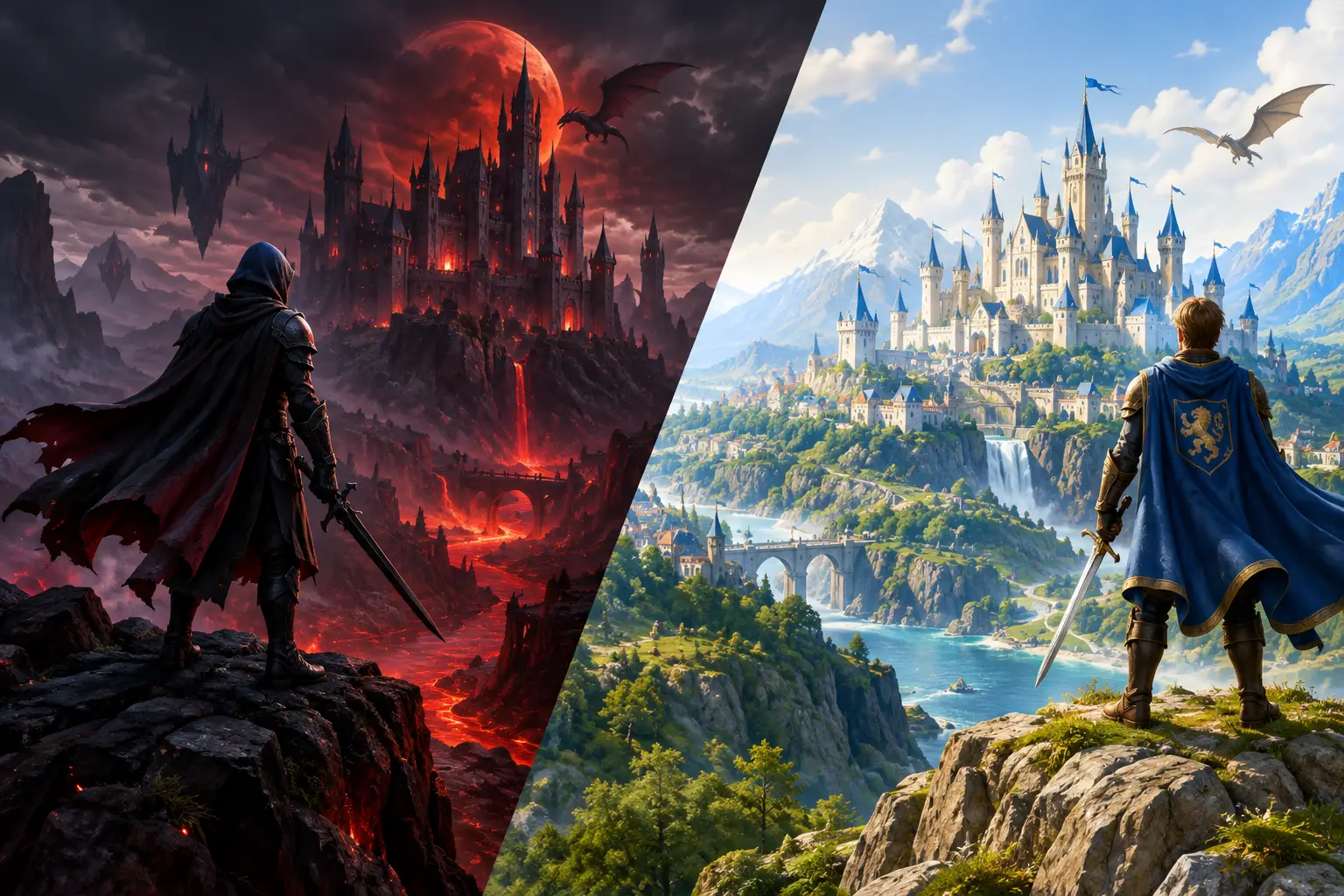
A throne room flooded with blood. A company of travelers crossing an ancient mountain pass beneath the eyes of gods. Both belong to fantasy, and both can hold a hero at the center of the tale. Yet dark fantasy versus epic fantasy is not simply a choice between grim shadows and sweeping maps. It is a question of what the world demands from those who dare to change it.
For roleplayers and collaborative writers, the distinction matters because genre shapes every decision. It changes the wounds your character carries, the kinds of victories they can earn, the dangers waiting beyond the next gate, and whether hope arrives as a sunrise or a candle stubbornly burning in a crypt.
Dark Fantasy Versus Epic Fantasy: The Core Difference
Epic fantasy is defined by scale. Its stories often unfold across kingdoms, continents, ages, or worlds. The fate of a people may turn on a prophecy, a war, a lost heir, or a relic powerful enough to redraw the order of creation. Heroes venture far from home because the conflict is larger than one village, one family, or one life.
Dark fantasy is defined more by atmosphere and moral pressure than by geographic reach. It brings horror, corruption, death, dread, and the supernatural close enough to touch. Its worlds may be vast, but they are rarely safe. Power comes with a price. Good intentions may create ruin. Monsters are not always separate from humanity.
The two genres can overlap completely. An empire-wide war against a necromancer king can be epic fantasy. If that war forces its heroes to bargain with the dead, sacrifice their innocence, and question whether the kingdom deserves saving, it is dark fantasy too.
The useful distinction is this: epic fantasy asks, “Can the world be saved?” Dark fantasy asks, “What will saving it cost, and who will you become afterward?”
The Shape of the World
In epic fantasy, the world often feels old, immense, and charged with destiny. History matters because it gives the present conflict weight. Fallen civilizations leave behind weapons, ruins, bloodlines, and songs. Distant realms feel connected by trade, war, magic, and legend. A character can begin as a farmhand, exile, or overlooked apprentice and still find a path into history.
That does not mean epic fantasy is cheerful. Great epics contain grief, betrayal, mass suffering, and terrible loss. But they often preserve a sense that courage, loyalty, and sacrifice can help restore what has been broken. Even when the hero falls, their choice may become a light for others.
Dark fantasy takes that inherited grandeur and lets rot creep through the stonework. The ancient empire may have been built on a god's corpse. The noble order of knights may be feeding prisoners to a holy relic. A city celebrated for its golden towers may survive only because something hungry sleeps beneath it.
This does not make dark fantasy nihilistic. The strongest dark fantasy usually protects hope precisely because hope is threatened. A mercenary who chooses mercy in a cruel world can feel more heroic than a spotless champion in a world built to reward virtue. The darkness gives moral choices their bite.
Heroes, Villains, and the Space Between
Epic fantasy tends to give characters clear horizons. They may not know their destiny at first, but the story often reveals a calling: unite the clans, reclaim the crown, guard the chosen one, defeat the invading force. The hero's inner conflict matters, yet their actions move toward an external reckoning.
Dark fantasy heroes are more likely to begin compromised. They might be cursed, disgraced, hungry for revenge, indebted to a demon, or loyal to a cause that has already failed them. Their central struggle can be intensely personal even when armies march around them. They are not necessarily less brave. They simply have fewer clean choices.
Villains follow the same divide. Epic fantasy often presents a figure or force whose defeat can change the world: a tyrant, dark lord, conquering empire, or primordial evil. Dark fantasy may still feature such a threat, but it is equally interested in the smaller cruelty that allows the great evil to thrive. The monster in the forest is frightening. The village that offers children to the monster is worse.
For roleplay, this creates different kinds of character momentum. An epic fantasy character may ask, “What cause am I willing to serve?” A dark fantasy character may ask, “What line will I refuse to cross when crossing it would save me?” Both questions can forge memorable legends.
Magic Reveals the Genre
Magic in epic fantasy often expands possibility. It may be wondrous, ancient, dangerous, or difficult to master, but it helps reveal a world larger than ordinary life. A spell can open hidden roads, heal a dying ally, awaken a sleeping fortress, or call down fire against an army. Magic makes the impossible feel reachable.
In dark fantasy, magic is often intimate and invasive. It leaves marks. It asks for blood, memory, years of life, or a promise that cannot be safely kept. Even benevolent magic may carry an unsettling origin. A healer can save a soldier, but perhaps the illness passes into the healer's own veins.
Neither approach is better. A bright, mythic magic system can make a shared world feel ripe for discovery. A costly, haunted system can make every spell feel like a scene worth playing. The choice depends on the story your group wants to create. If players want daring expeditions and rising legends, magic may need room for wonder. If they want tense bargains and consequences that linger, it should demand something real.
Stakes Are Not the Same as Scale
A common mistake is to assume dark fantasy means low stakes and epic fantasy means world-ending stakes. In truth, either genre can work at any scale.
A dark fantasy story can stretch across continents. A plague carried by dream-eating spirits could threaten every realm, while the only cure requires each ruler to surrender a cherished dead ancestor. That is vast in scope and deeply dark in spirit.
An epic fantasy story can remain close to home. Protecting one mountain valley from conquest can feel epic when the valley holds a sacred pass, a culture on the edge of extinction, and generations of history. The emotional scale comes from what the characters stand to lose, not merely from how many cities appear on the map.
For collaborative storytelling, begin with the stakes players can feel. A threatened crown is abstract until someone has sworn an oath to it. A cursed forest becomes unforgettable when it contains the grave of a character's sister. Let personal consequence give large events a pulse.
How to Choose the Right Tone for Your Story
Choose epic fantasy when your group wants to travel widely, confront history, build alliances, and place characters near the turning points of an age. It is especially satisfying for players who love noble quests, political struggles, lost civilizations, and the exhilaration of gathering scattered heroes for an impossible cause.
Choose dark fantasy when your group wants danger with teeth. It serves characters who carry secrets, pursue dangerous power, survive hostile institutions, or struggle to stay human in an inhuman place. It gives writers room to explore fear, grief, temptation, and hard-won trust without reducing those themes to despair.
Choose both when you want the richest tension. Let the map be immense, the old legends true, and the threat worthy of songs. Then let every victory leave a scar. A kingdom can be saved while a hero loses their name. A god can be slain while its death curse changes the sea. A rebellion can triumph and discover that freedom needs more than an enemy's defeat.
That balance is where a world like Continents of Delarom finds its strength: broad realms invite discovery, while darkness ensures that no road is merely decorative. Every traveler has something to risk. Every choice can become part of the world's living memory.
Write the Legend Only Your Hero Can Carry
Genre is not a cage. It is a promise to your fellow storytellers about the kind of meaning your scenes will pursue. Epic fantasy promises that actions can echo across nations and ages. Dark fantasy promises that those echoes may return in a voice you never expected.
Forge a hero who belongs in the promise you choose. Give them a wound, a desire, and a reason to step into the unknown. Then place them before a door that should remain closed, a crown no one deserves, or a night that seems too deep to survive. Whether they emerge carrying a banner or a curse, let their choices write the legend.