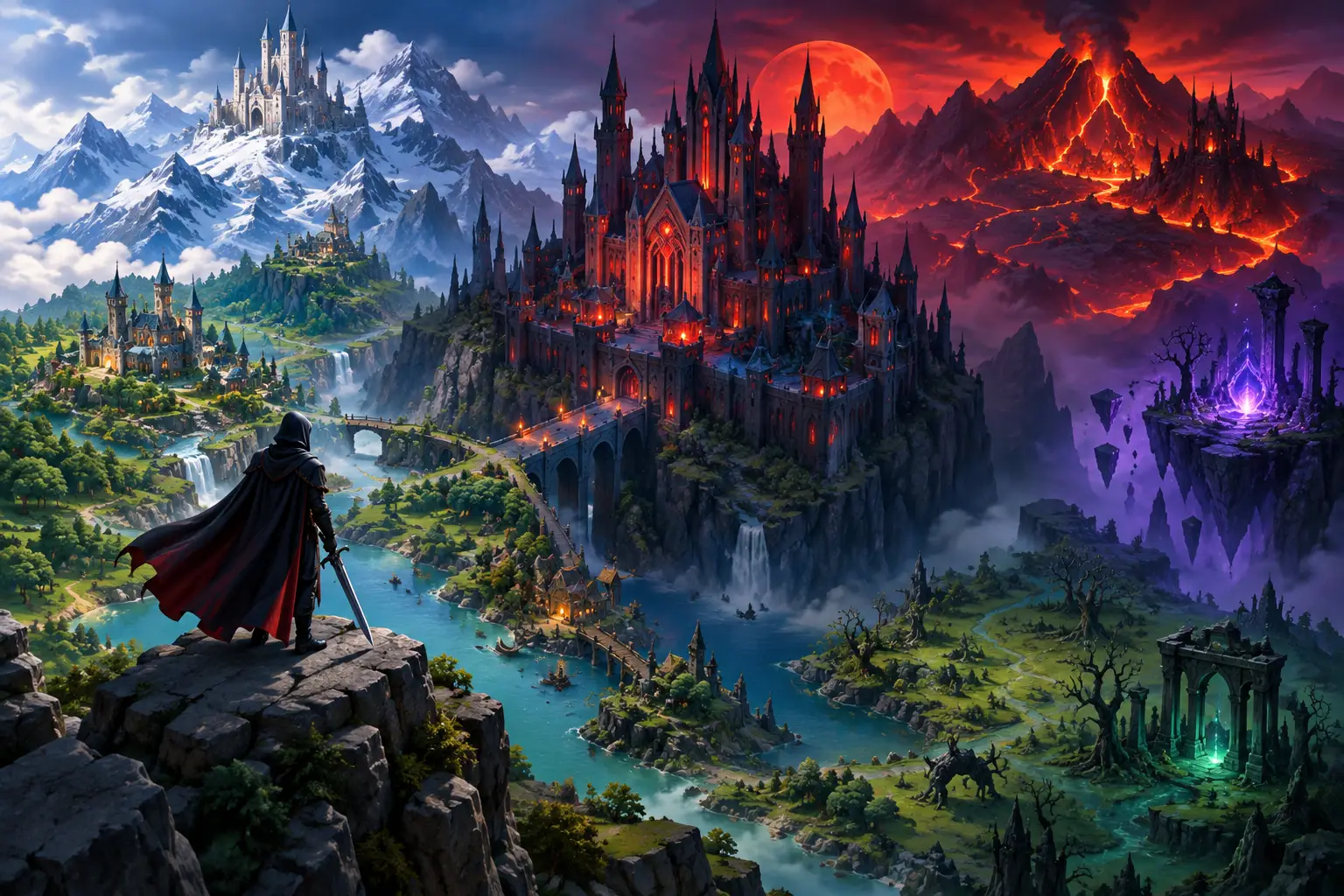
A crown hangs from a dead king’s hand. Beyond the throne room, something ancient scratches beneath the castle stones. These dark fantasy examples show why a realm becomes memorable when wonder and terror share the same sky. Darkness is not merely blood, grief, or a grim color palette. It is the pressure placed on a hero when every path asks for a sacrifice.
For roleplayers and worldbuilders, the genre offers more than a mood. It gives your character choices with teeth. A knight can keep an oath and doom a village. A healer can save a life by serving a god she despises. A thief can steal a relic, only to discover it remembers every hand that has held it.
What Makes These Dark Fantasy Examples Endure?
Dark fantasy brings the supernatural into conflict with human frailty. Its worlds may contain dragons, sorcerers, saints, and empires, but none of those things guarantee safety or justice. Magic carries a price. Power corrodes. Even victory can leave a scar that changes the victor.
That does not mean every story must be hopeless. The strongest dark fantasy often protects a small, fierce flame of hope. Kindness matters precisely because the world makes it difficult. A character’s courage becomes legendary not because they were chosen without cost, but because they chose to act when fear had every reason to rule.
Grimdark and dark fantasy overlap, yet they are not identical. Grimdark tends to focus on cynical politics and moral compromise. Dark fantasy may do that too, but its defining force is the intrusion of dread: curses, monsters, haunted bloodlines, forbidden rites, and places where reality has gone wrong.
12 Dark Fantasy Examples Worth Studying
1. Berserk
Kentaro Miura’s Berserk is a towering example of a world where ambition opens a gate to cosmic horror. Its mercenaries, kingdoms, and rivalries begin in familiar medieval territory, then reveal a universe shaped by fate, sacrifice, and monstrous desire.
For roleplay, study Guts. He is not compelling because he is untouched by darkness. He is compelling because he keeps moving through it. Give your hero a wound that affects their choices, not just their appearance.
2. The Witcher
In The Witcher, monsters are real, but the people hiring a witcher are often more dangerous. Geralt’s world makes moral certainty difficult without suggesting morality is meaningless. A choice between two evils can still reveal character.
This is useful for creating quests. Do not ask only, “Can the party kill the beast?” Ask who benefits if the beast dies, what it protects, and whether the curse began with an injustice no sword can cleanly solve.
3. Dark Souls
Dark Souls makes ruin into a language. Crumbling towers, silent gods, undead warriors, and broken rituals tell a history long before anyone explains it. The player feels small, but never irrelevant.
Borrow this approach for a realm with layered ruins. Let a shattered statue, a sealed chapel, or a battlefield full of rusted banners imply an old betrayal. Your characters can uncover the past gradually, then decide whether it deserves restoration.
4. Elden Ring
Where Dark Souls is compressed and haunted, Elden Ring sprawls beneath a fractured cosmic order. Every region feels touched by a different calamity, from rot and flame to celestial influence and divine war.
Its lesson is scale. A dark fantasy world can be vast without becoming vague when each land has its own wound. Forge realms with distinct fears: a coast where drowned nobles return with the tide, or a mountain where prayers freeze before reaching heaven.
5. The Black Company
Glen Cook’s The Black Company follows hardened soldiers in the service of a terrifying ruler. The brilliance lies in its perspective. The story is not told from a throne or prophecy, but from exhausted people trying to survive a war between powers beyond them.
Use this example when building a character group. A shared contract, campaign, or debt can bind heroes who would never call one another friends. Their loyalty becomes meaningful because it must survive ugly orders and impossible odds.
6. Between Two Fires
Christopher Buehlman’s Between Two Fires turns medieval plague into spiritual terror. Demons, fallen angels, and devastated villages create a world where faith is not comfortable refuge but a battlefield.
The key craft lesson is atmosphere through consequence. A plague should change trade, burial rites, superstition, family bonds, and who holds authority. When a supernatural disaster reaches every corner of daily life, the world feels lived in rather than decorated.
7. Pan’s Labyrinth
Guillermo del Toro’s Pan’s Labyrinth places fairy-tale imagery beside the brutality of fascist Spain. Its magic is beautiful, strange, and never entirely safe. Innocence does not erase horror, but it can confront it with a courage adults have forgotten.
For a roleplay arc, contrast is the weapon. Place a luminous moon garden beside a prison fortress. Give a child’s nursery rhyme the power to open a tomb. Beauty can make the darkness sharper, and the darkness can make beauty worth defending.
8. The First Law
Joe Abercrombie’s The First Law is known for sharp characters, brutal humor, and people who repeatedly discover that being better is harder than sounding better. Its magic and ancient powers lurk behind a world of war, vanity, and political maneuvering.
This is a strong model for flawed heroes. Give characters ideals they genuinely believe in, then test those ideals with rewards, fear, and resentment. A hero who fails can still become fascinating if they must live with what failure cost.
9. Diablo
The world of Diablo is built on an endless struggle between heavenly and infernal powers, yet ordinary people bear much of the suffering. Cathedrals become crypts. Villages become sacrificial sites. Salvation always seems one ritual too late.
Its value for creators is visual clarity. Choose symbols that carry your realm’s terror: black candles, weeping stone saints, thorn-crowned angels, bells that ring without a hand. Repeated imagery gives darkness a recognizable face.
10. Castlevania
Across its games and animated stories, Castlevania turns the vampire castle into a living monument to grief, revenge, and corrupted grandeur. The castle is not simply a backdrop. It is an adversary shaped by the sorrow of those who command it.
Build locations with motives. A cursed manor might rearrange halls to separate lovers. A city wall could reject anyone who has spilled kin-blood. When a place responds to characters, exploration becomes a confrontation rather than a tour.
11. Bloodborne
Bloodborne begins as gothic monster hunting and unfolds into cosmic horror. The more its hunters seek forbidden knowledge, the less human the truth becomes. Its central dread is not ignorance alone, but the possibility that understanding will transform you.
That tension creates excellent magical rules. Let forbidden power solve a real problem while altering the user’s senses, dreams, memory, or loyalties. The best curse is tempting enough that a good person might willingly accept it.
12. The Broken Empire
Mark Lawrence’s The Broken Empire follows Jorg Ancrath, a protagonist whose cruelty makes him deliberately difficult to admire. It is not a model for every table or every character, but it demonstrates how voice can make a brutal world immediate.
The trade-off matters. A relentlessly vicious protagonist can narrow collaboration and make fellow players feel like props. If you draw from this kind of darkness, establish boundaries and give other characters meaningful power to resist, change, or walk away.
Turn Inspiration Into a Living Legend
Do not copy the surface of these stories. A black castle, cursed blade, or tragic vampire becomes forgettable when it exists only to look dark. Ask what the curse demands, who profits from the castle, and why the blade was forged. Then place a choice in your hero’s hands.
A dark fantasy character does not need to be cruel, doomed, or born beneath an evil star. They need something worth protecting when protection becomes dangerous. Perhaps they carry the last map to a sunless continent. Perhaps their family name opens doors that should remain sealed. Perhaps the monster hunting them once saved their life.
In Continents of Delarom, the most enduring legends need not belong to spotless champions. Forge the hero who enters the forbidden wood anyway, speaks to the thing beneath the ruined cathedral, and decides what kind of person they will be when the stars offer no easy answer.